
Vampire Survivors Review
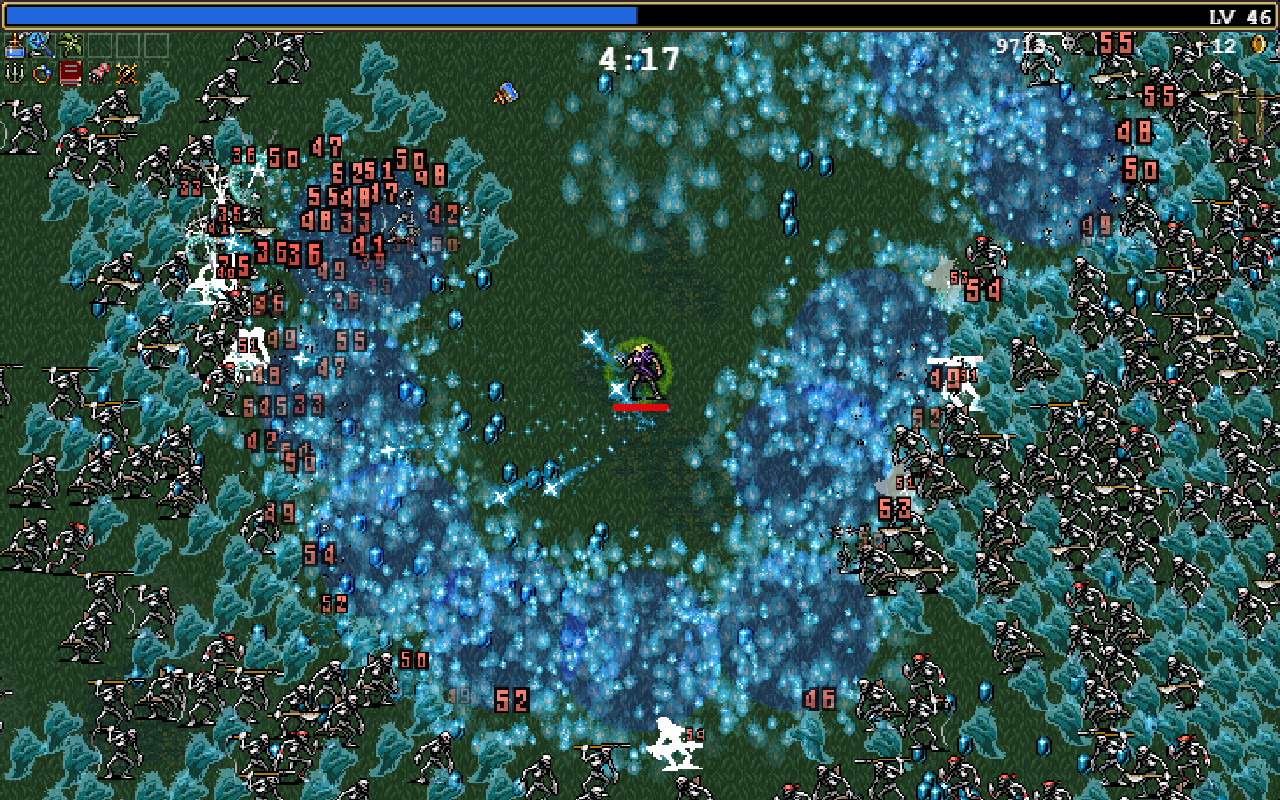
After 47 hours with Vampire Survivors, here's where Poncle's latest lands on the Roguelike Auto-shooter ladder.
Vampire Survivors launched into Steam Early Access in December 2021 for one dollar, made by a single developer — Poncle, the studio identity of Luca Galante — and proceeded to quietly eat the internet. By the time it hit full release in October 2022, it had logged tens of millions of players and spawned a subgenre that everyone suddenly needed to have an opinion on. Forty-seven hours in, across the base game and its paid expansions including Legacy of the Moonspell and Tides of the Foscari, here is mine.
The elevator pitch is well-worn by now: your character attacks automatically, you pick power-ups every few levels, and you survive for thirty minutes against increasingly absurd enemy density. What that description fails to capture is the specific texture of decision-making that keeps the loop interesting — or, depending on the build and the stage, fails to. This is not a strategy game in the Paradox sense, but for readers who live in Civilization VI and Dominion, there is more combinatorial thinking here than the screenshots suggest.
The Build System Is the Whole Game
Vampire Survivors gives you six weapon slots and six passive item slots. Each weapon can be evolved into a more powerful form by pairing it with a specific passive and reaching a certain level cap, provided you find a chest after hitting that threshold. The Whip evolves into Bloody Tear when paired with Hollow Heart. The Magic Wand becomes Holy Wand with an Empty Tome. There are over thirty evolutions and unions across the base game and expansions, and knowing which pairings exist — and which passive items serve double duty across multiple evolutions — is genuinely the skill floor.
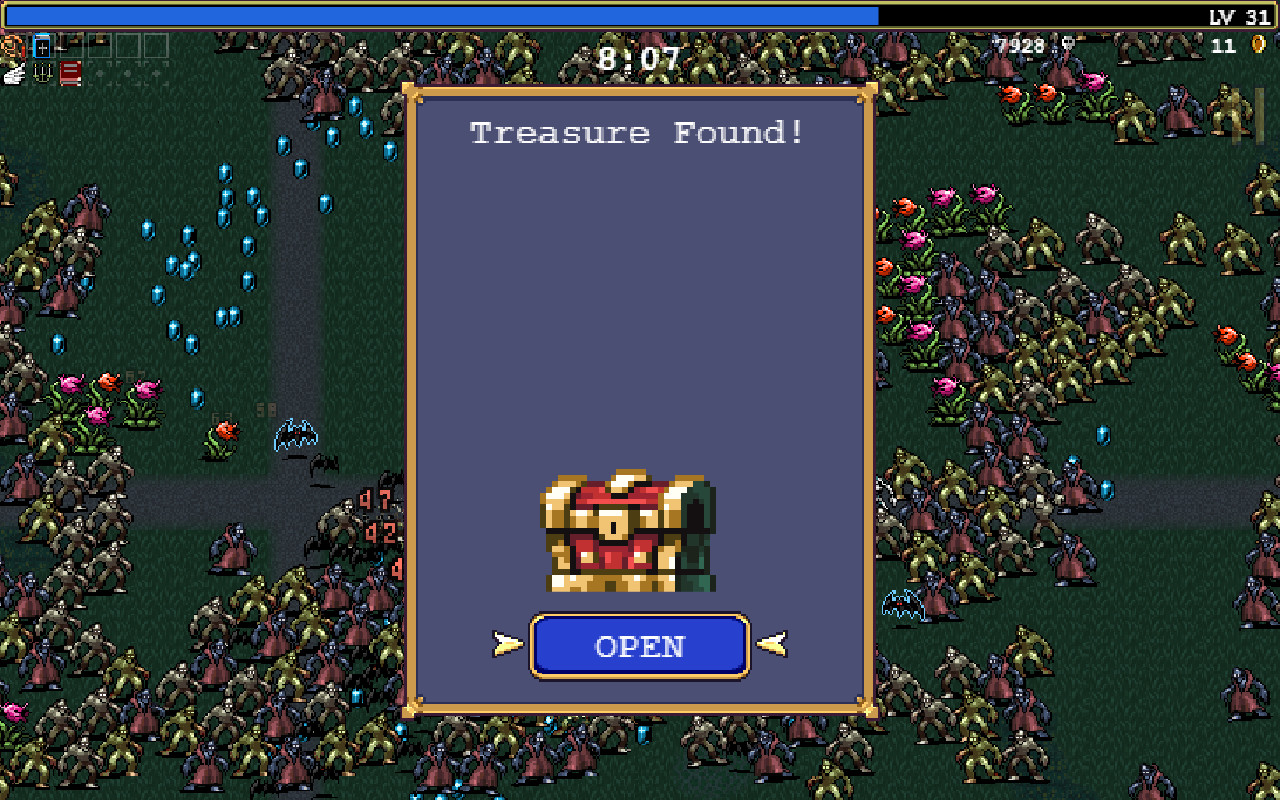
The early game on any new character is a triage exercise. You are picking from a random selection of three or four items per level-up, and the correct read is always contextual: what have I already committed to, what is this character's innate bonus, and what does the stage's enemy pattern demand? Poe Ratcho, for instance, starts with Garlic and a raw HP bonus, which steers you naturally toward the melee-adjacent cluster of evolutions. Trying to pivot him into a projectile build because the early drops were generous with wands tends to fall apart by the fifteen-minute mark when the screen fills.
What the system does well is make almost every run feel directional from around minute five onward. You are rarely drifting. The weak point is that once you have a working mental model of the evolution list — which happens faster than you'd expect, maybe eight or ten hours in — the decisions become more confirmatory than exploratory. You stop discovering and start executing. That's not fatal, but it's worth naming.
Stage Design and the Density Problem
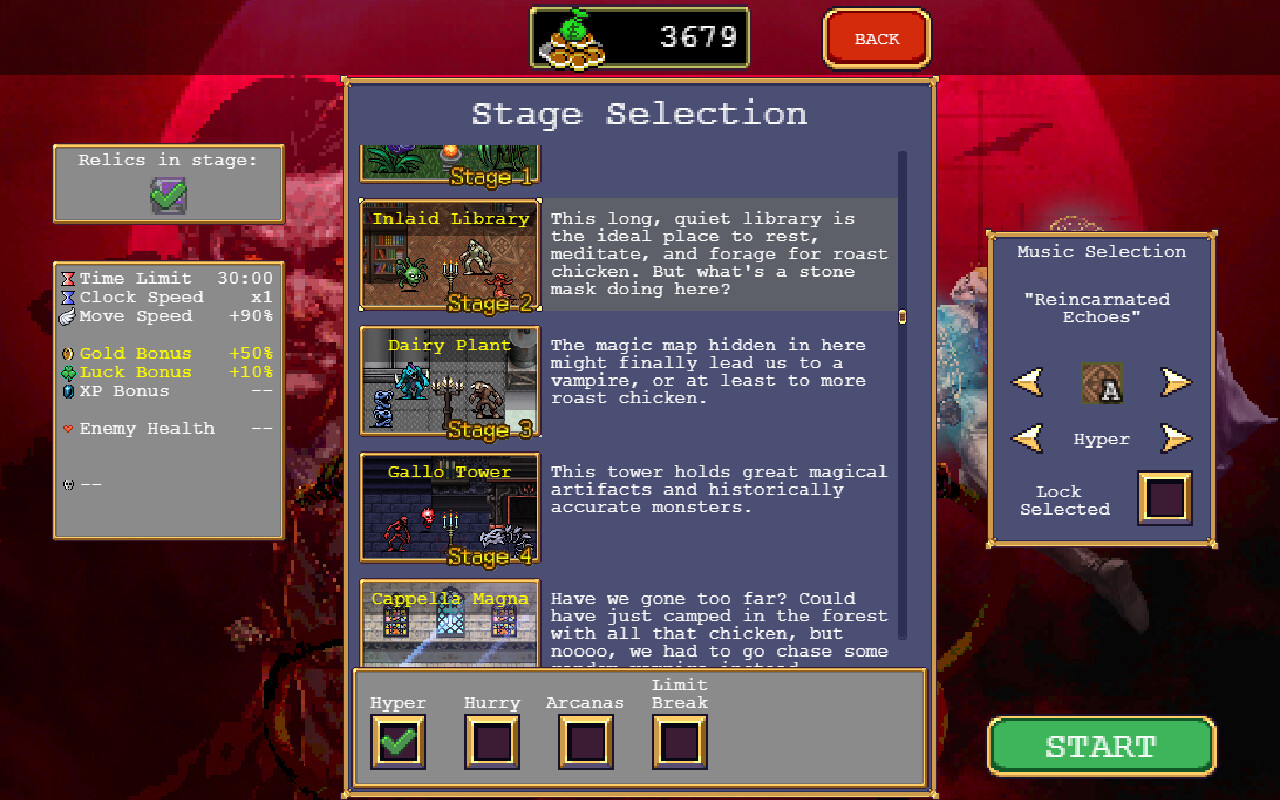
The maps range from the starting Mad Forest, a flat grass expanse with light verticality, to the more structured library of Il Molise and the distinctly Japanese-inflected Moongolow added in later patches. Each stage modifies enemy composition and introduces stage-specific mechanics — the Dairy Plant has a moving cow herd that resets your position bonus if you let it crowd you, which is a small but effective wrinkle. Stage selection matters more than casual commentary on the game usually acknowledges.
The density scaling is where the game shows its seams around the two-year-old content. Early stages ramp enemy count in a way that still produces readable threat — you can see corridors forming in the crowd that a well-placed King Bible or Runetracer can exploit. The later DLC stages, particularly some of the Tides of the Foscari maps, push density faster and reward area-clear builds almost exclusively. That narrows the viable build space in ways that feel less like intended difficulty and more like a design team that had learned to trust the player less.
The thirty-minute timer with the Reaper arrival at the end is still one of the more elegant tension devices in the genre. You know the hard stop is coming, which reframes the last five minutes entirely. Runs that were comfortable suddenly require attention. It's a cheap trick that works every time.
Unlocks, Meta-Progression, and the Spreadsheet Problem
Vampire Survivors has a substantial unlock tree. Characters, stages, weapons, passive items, and game modifiers called Arcanas are gated behind specific in-run actions: find a particular item, reach a certain floor, kill a boss that only spawns under conditions you may not encounter for several runs. The Arcana system, added in a free update and substantially expanded in the Moonspell DLC, layers a card selection at intervals that modifies your build's fundamental math — Sarabande of Healing makes recovery items deal damage, which sounds marginal until it enables an entire healing-offense hybrid approach.
The problem is that much of this is opaque in ways that stop being charming after a point. The Directer unlock, the Toastie easter egg sequence, several of the secret characters — these require either community wikis or the specific patience of someone who finds blank-slate experimentation intrinsically rewarding. For strategy players coming from games like Slay the Spire, where the card and relic interactions are at least visible and described in text, Vampire Survivors' hidden information design can feel like a different and occasionally frustrating contract.
That said, the meta-progression currency — Gold coins spent at the in-game shop between runs — is well-calibrated. Powerups compound meaningfully, and the shop does not simply inflate your starting stats; several purchases open new mechanics entirely, like the ability to limit-break weapons past their normal cap. The forty-seven hours did not feel padded by artificial gates. There was almost always a concrete next target.
Where It Sits in the Genre
The auto-shooter subgenre Vampire Survivors catalyzed now includes Brotato, 20 Minutes Till Dawn, Halls of Torment, Deep Rock Galactic: Survivor, and a dozen others with varying degrees of mechanical depth. Comparing them is instructive. Brotato has tighter active input demands and more granular stat itemization. 20 Minutes Till Dawn rewards manual aim and builds its tension through different tempo. Halls of Torment leans into ARPG-adjacent character progression that will feel familiar to Diablo veterans.
Vampire Survivors sits at the passive, zen-adjacent end of that spectrum. Your direct input — movement — matters less than in most of its successors. The game has never pretended otherwise. What it offers instead is the particular satisfaction of a build clicking into place around minute twenty and turning the screen into a coherent, self-sustaining system. That is its own pleasure, distinct from the active shooter pleasure. Neither is objectively correct.
Poncle has also been consistently generous with free content updates while keeping DLC pricing reasonable — Legacy of the Moonspell and Tides of the Foscari each launched at under three dollars. That pricing context matters when evaluating the value proposition. Emergency Meeting, the Among Us crossover content, is arguably skippable. The rest has earned its place.
The Presentation Is Doing More Work Than It Looks Like
The retro pixel art is not a limitation; it is a deliberate frame that keeps enemy identification legible at extreme density. When four hundred bats are onscreen, you need silhouette clarity above everything else, and the sprite work delivers that. The audio design deserves specific credit: each weapon has a distinct hit sound, evolution moments are punctuated with a brief musical sting, and the stage-specific soundtracks range from serviceable to genuinely good. The Inlaid Library track has been in my head at intervals for several months.
Performance on Steam Deck is strong, which matters for a game that lends itself to short-session play. The late-run particle effects do cause occasional frame dips on older hardware, but Poncle has addressed this repeatedly in patches and added a legacy rendering option for lower-end machines. The mobile port, released in 2022, runs well but loses something in the session flexibility since the same run length that feels brisk on a PC or Deck becomes a commitment on a phone.
Who This Is Actually For
Vampire Survivors is not a deep strategy game. Readers who spend their evenings in Crusader Kings III managing succession laws or tuning Dominion deck compositions may find the decision space here too shallow to sustain long engagement. The first fifteen hours are likely to satisfy regardless of background. Beyond that, staying power correlates strongly with how much you enjoy optimization for its own sake — finding the one character and Arcana combination that clears the final boss, Ender, in under ten minutes, not because the game demands it but because you want to see if it's possible.
For the roguelike-curious who haven't committed to Slay the Spire's steeper learning curve or Hades' combat depth, this remains the most accessible on-ramp in the genre. At five dollars for the base game, the question isn't really whether it's worth it. It is. The question is whether you're the kind of player who wants to push past hour twenty, into the unlock checklist and the secret characters and the absurd final-stage challenges — or whether you're content to run the Mad Forest for an evening and move on. Both relationships with the game are valid. Vampire Survivors is smart enough not to require you to justify yours.
Verdict
| Category | Score |
|---|---|
| Gameplay | 8/10 |
| Story | 8/10 |
| Visuals | 6/10 |
| Replayability | 8/10 |

Hanan Amir
Hanan covers stealth (Hitman, Splinter Cell) and tactical games. Patience metric is off the charts.
Frequently Asked Questions
How long does it take to finish Vampire Survivors?
Main story runs around 30-40 hours depending on how thoroughly you explore. Completionists can spend 2-3× that.
Is Vampire Survivors good for newcomers to Roguelike Auto-shooter?
Yes — Vampire Survivors is a great entry point. The early hours teach the systems gradually and the difficulty curve is reasonable.
Which platform should I play Vampire Survivors on?
Console version is the most stable on launch. PC version benefits from the modding scene long-term.
Was Vampire Survivors worth the launch-day price?
Released in 2022, and as of writing it holds up. Wait for a sale if you're price-sensitive — major discounts arrive within 6 months.
Are there DLCs or expansions worth picking up?
Wait for the Game of the Year edition — it bundles everything at a fair discount.
What did Poncle get right (and what could be better)?
Poncle nailed the moment-to-moment loop and the world-building. Pacing in the mid-game and inventory UX have room for improvement.


Comments (6)
Solid review. I bounced off Vampire Survivors for the first 5 hours, then it clicked.
Spent 60 hours with this. Worth every minute.
The pacing in the second act is exactly the issue that gets glossed over in most reviews.
Wish more outlets pushed back on the difficulty spike around hour 10.
Bookmarked for when it drops to half price. Cheers for the honest writeup.
Multiplayer mode adds 30+ hours of replay value. Underrated section.