
Disco Elysium Review
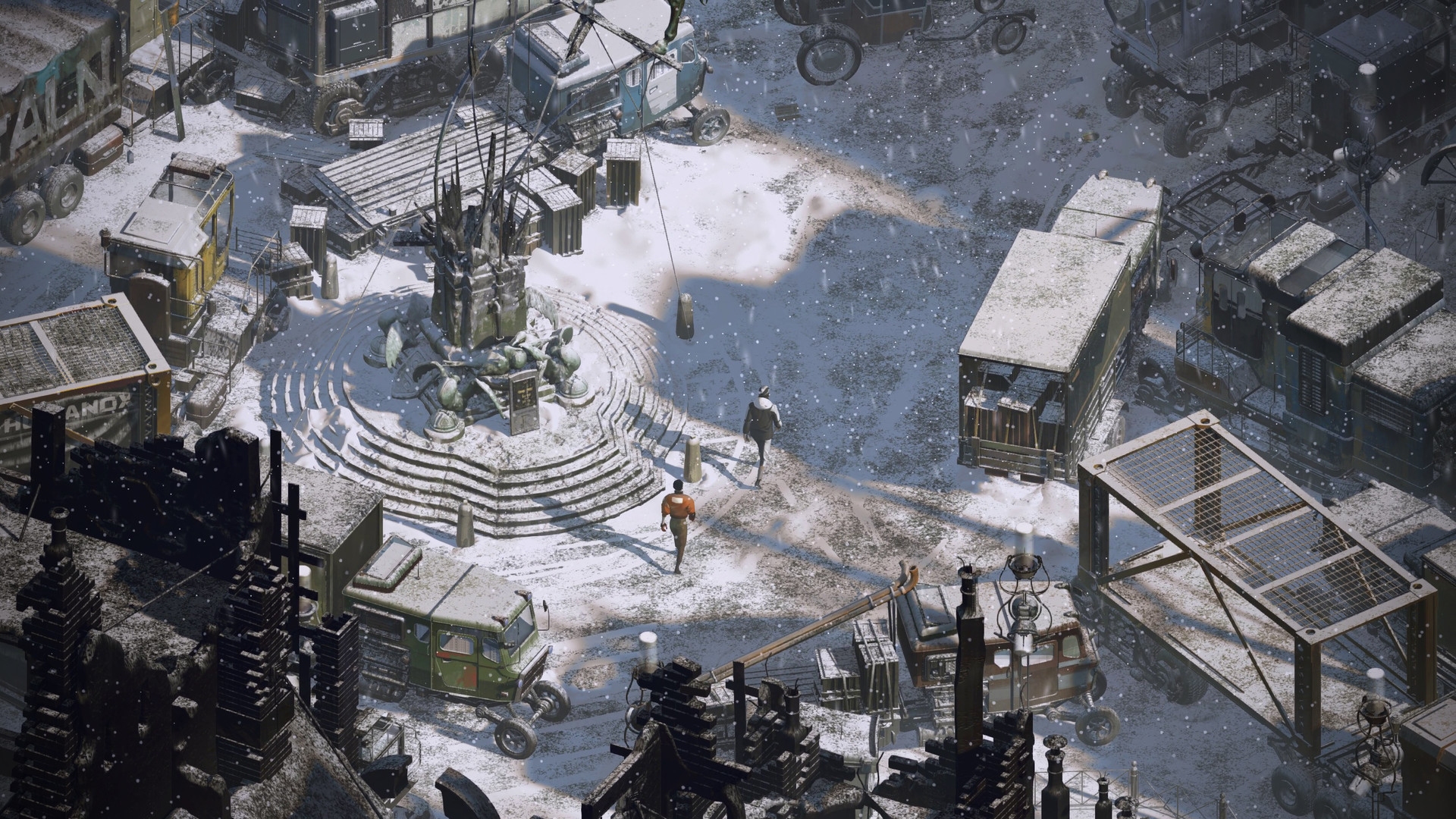
After 24 hours with Disco Elysium, here's where ZA/UM's latest lands on the Narrative RPG ladder.
Disco Elysium arrived in October 2019 from Estonian studio ZA/UM, and nothing quite prepared the genre for what it was. Not an RPG in the mechanical sense most players expected — no swords-and-sorcery combat loops, no loot treadmills — but a dialogue-driven investigation set in the fictional city of Revachol, built almost entirely on a 24-skill check system and a script that runs to roughly a million words. After spending 24 hours with it, the question isn't whether it's good. It obviously is. The question is what kind of good, and whether that goodness holds up past the opening act's remarkable first impression.
The setup: you play Harry Du Bois, a detective who wakes in a ransacked hotel room with no memory, no shoes, and a corpse hanging from a tree in the courtyard outside. Your partner, Lieutenant Jean Luc Vicquemare's stand-in Kim Kitsuragi, arrives shortly after and becomes the competent, quietly judgmental anchor to Harry's chaos. What follows is a murder investigation that keeps expanding — politically, philosophically, geographically — until it stops being about a murder at all. ZA/UM wrote a game about ideology, addiction, grief, and the slow erosion of a man who once believed in something.
The Skill System Is the Game
Disco Elysium distributes Harry's psyche across 24 skills, grouped into four loose categories: Intellect, Psyche, Physique, and Motorics. Each skill is also a voice in Harry's head — a distinct personality that interjects during conversations and environmental interactions. Raise your Electrochemistry stat high enough and it will actively advocate for you to take drugs. Neglect Empathy and you'll miss character reads that reshape how certain conversations resolve. The system isn't about optimisation in the way Pathfinder: Wrath of the Righteous demands build literacy. It's about which version of Harry you're constructing, and which version of the world that Harry gets to perceive.
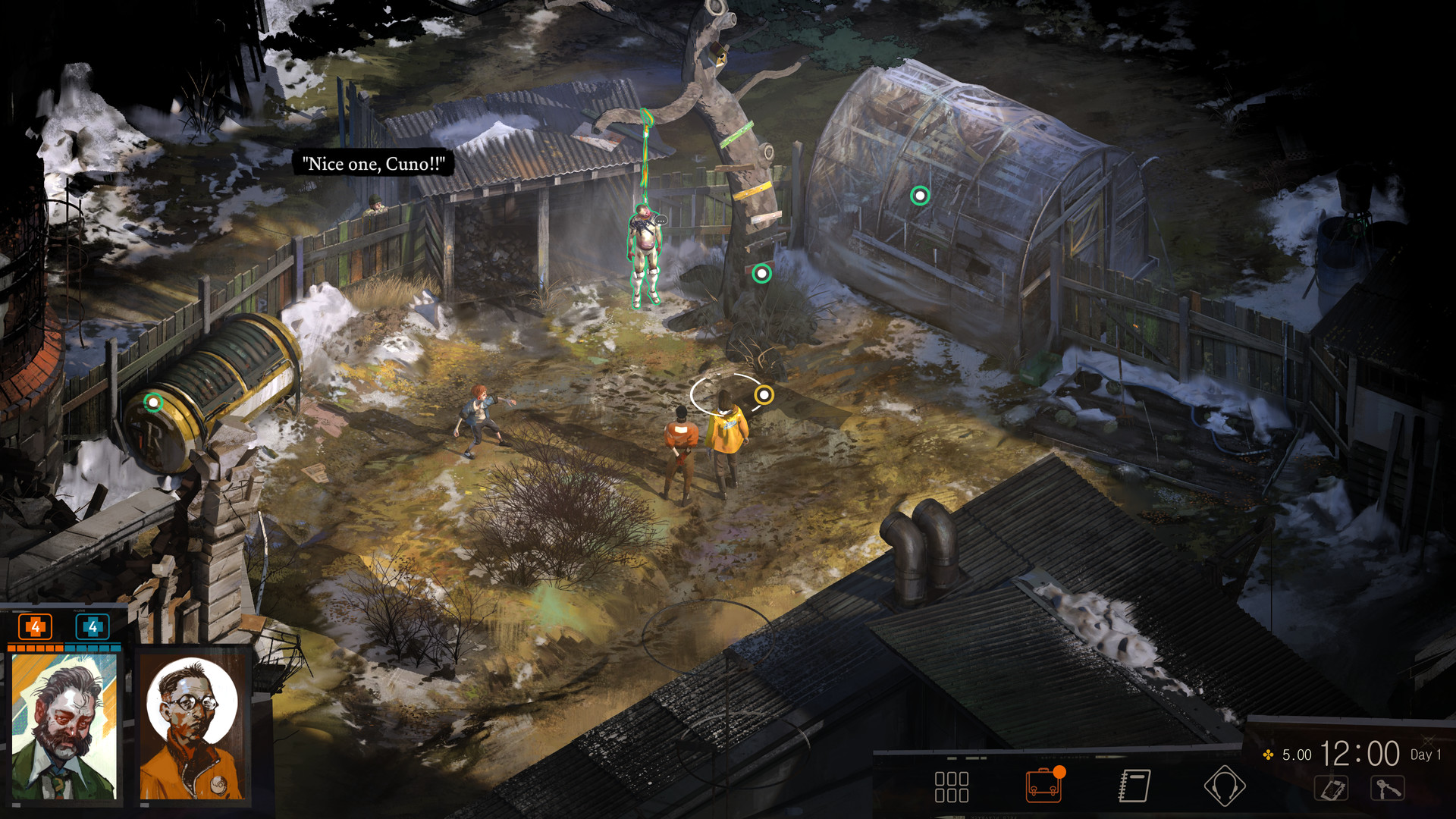
Skill checks use a two-d6 system with modifiers, meaning failure is always possible and sometimes deliberate. ZA/UM did something clever here: failed checks frequently produce more interesting narrative outcomes than successful ones. Fail a Rhetoric check during a debate with a union organiser and Harry doesn't just lose the argument — he embarrasses himself in a specific, character-revealing way that feeds back into subsequent scenes. This is design that trusts its own writing, which is rarer than it should be.
The tension comes from resource scarcity. Skill points at character creation are limited, and you can't max everything. Early decisions about which skills to invest in shape which doors stay closed for the entire run. A high-Conceptualization Harry notices artistic details across Martinaise that a Physique-heavy bruiser Harry will walk past entirely. Replayability is genuine rather than cosmetic — different builds produce meaningfully different games.
Revachol as a City Worth Reading
The district of Martinaise — the game's primary setting — is roughly the size of a small city block, but it's dense in a way that makes most open-world games look embarrassingly thin. Every building has history. Every NPC has a position on the political spectrum that's been thought through. The Pale, a reality-eroding phenomenon that eats geography and memory, sits on the edge of the world and functions as both literal threat and metaphor without the game ever feeling the need to explain itself too carefully.
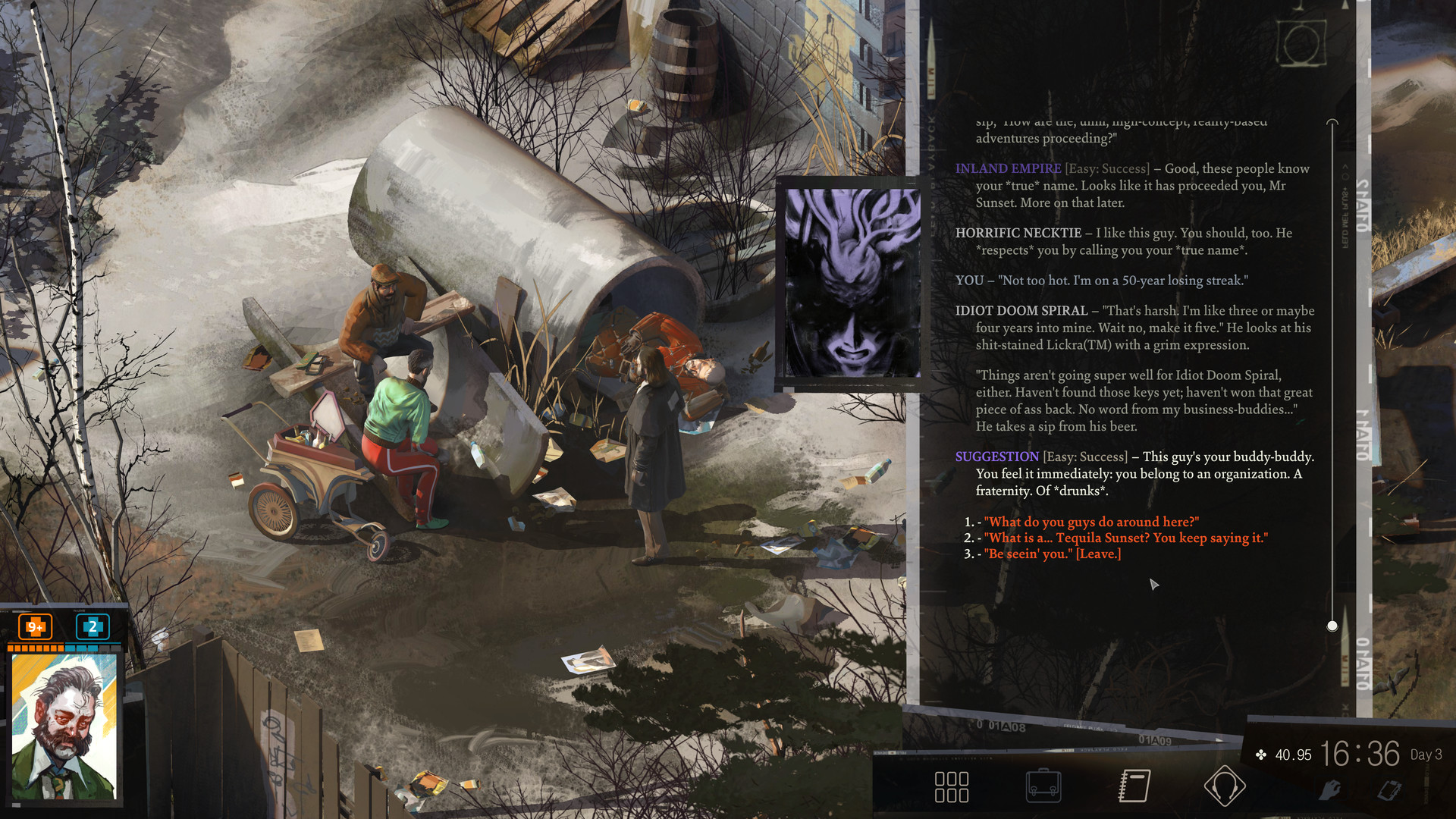
ZA/UM built Revachol's history — the failed communist revolution, the subsequent occupation, the grinding poverty — with the kind of specificity that gives the setting weight without requiring a lore-dump. You piece it together through conversations with a dock worker who still believes, through graffiti on crumbling walls, through the specific way different characters talk about the Commune of Revachol as either tragedy or cautionary tale. It's worldbuilding through texture, closer to how Planescape: Torment handled the Outlands than how most modern RPGs handle exposition.
The city also changes in response to Harry's reputation. Push too hard on certain investigation threads and NPCs react differently. Arrive drunk at a critical interview and watch a carefully managed conversation unravel. The world isn't reactive in the systemic way Dwarf Fortress calculates geology, but it's reactive in the way good fiction is reactive — characters remember, consequences accumulate, the past keeps showing up.
Where the Pacing Strains
Around the 10-to-14 hour mark, after the initial density of Martinaise starts to resolve into clearer investigative threads, Disco Elysium hits a wall. Several key story beats require completing prerequisite tasks that aren't clearly signposted, and the player can spend real time wandering the same few screens waiting for an NPC to become available or a locked container to become relevant. The game's journal system logs everything but organises nothing, which means cross-referencing leads feels more like rereading a document dump than following an investigation.
This isn't a fatal flaw — it's a structural one. ZA/UM clearly prioritised the richness of individual moments over the connective tissue between them. The result is that Disco Elysium plays beautifully in short sessions and sometimes punishes longer ones, when the player is alert enough to notice they've been asked to talk to the same person for the fourth time without meaningful new information. Players who've recently come from something with tighter quest architecture — Larian's Baldur's Gate 3, for instance, where quest flags are meticulously tracked — may feel the absence of that scaffolding sharply.
The Writing, Specifically
Lead writer Robert Kurvitz, co-writers Argo Tuulik and Helen Hindpere, and the extended ZA/UM team produced something that's genuinely difficult to write about without quoting at length. The prose is sharp in a way games almost never manage — funny when it needs to be, bleak when it earns it, and occasionally doing both in the same sentence. The Inland Empire skill, which governs Harry's capacity for magical thinking and intuition, produces some of the most unsettling internal monologue in the medium. At one point a necktie speaks to you. It's written with complete sincerity, and it works completely.
The political writing is what tends to generate the most discussion, and for good reason. Disco Elysium engages seriously with Communism, Fascism, liberalism, and moralism as in-game ideological stances Harry can adopt, each with mechanical consequences and NPC reactions. None of them are presented as simply correct. The fascist characters aren't cartoon villains; the communist true believers aren't uncomplicated heroes. This is writing that respects the reader enough to present ideas without always telling you what to think about them — which remains unusual enough to deserve explicit mention.
How It Sits Against the Genre
Narrative RPG is a loose label that covers everything from Supergiant's Hades — which uses story to reward mechanical repetition — to Obsidian's Pentiment, which is nearly pure historical fiction with light interaction. Disco Elysium is closer to Pentiment than to anything combat-driven, but it has more mechanical depth than Pentiment's branching dialogue because the skill system creates persistent character states that Pentiment's simpler attribute choices don't quite replicate.
Against Planescape: Torment, the 1999 Black Isle game it's most frequently compared to, Disco Elysium holds up well and in some ways exceeds it. The writing is more consistent, the setting more fully realised, the mechanical integration tighter. Torment's combat was always an obligation ZA/UM correctly decided to remove entirely. The comparison that keeps surfacing after 24 hours, unexpectedly, is with Crusader Kings III's character system — not in tone, but in the way both games make internal psychology feel like a resource pool with real constraints.
The Score Deserves Its Own Paragraph
British Sea Power — now just Sea Power — composed the soundtrack, and it's doing more structural work than most game scores manage. The music in Disco Elysium doesn't score moments the way a conventional RPG score would. It scores states of mind. The ambient drone that sits under the Martinaise waterfront at night sounds like the specific melancholy of somewhere that used to mean something. Tracks like 'The Pale' and 'Dolores Dei' are not background noise; they're arguments about tone. The audio direction understood what the writing was doing.
Disco Elysium is a game about a man trying to reconstruct an identity from wreckage while the city around him does the same thing on a larger scale. It doesn't resolve tidily. After 24 hours, it sits somewhere near the top of the narrative RPG category — not because it's flawless, but because its specific ambitions are so clearly achieved, and because what it's attempting is harder and more interesting than what most games in the genre try. If you've been waiting for something to take Planescape: Torment's slot in the canonical list, you can stop waiting.
Verdict
| Category | Score |
|---|---|
| Gameplay | 5/10 |
| Story | 7/10 |
| Visuals | 5/10 |
| Replayability | 5/10 |

Cal Burke
Cal champions the 'walking sim' genre. Has the longest entry on What Remains of Edith Finch on the site.
Frequently Asked Questions
How long does it take to finish Disco Elysium?
Main story runs around 12-15 hours depending on how thoroughly you explore. Completionists can spend 2-3× that.
Is Disco Elysium good for newcomers to Narrative RPG?
For total newcomers, expect a 5-8 hour ramp-up. Once you internalize the loop, it clicks.
Which platform should I play Disco Elysium on?
Steam Deck handles this title well — verified compatibility on most recent patches.
Was Disco Elysium worth the launch-day price?
Depends on backlog. The replay value justifies the price for genre fans; casual players should wait for a 40%+ discount.
Are there DLCs or expansions worth picking up?
Skip the cosmetic DLC. The story expansion is the only one we'd recommend at full price.
What did ZA/UM get right (and what could be better)?
Strongest: art direction, audio design, set-piece variety. Weakest: late-game balance and a few persistent quest-log bugs.
Comments (7)
How does it compare to ZA/UM's previous work? That's the real question.
Did you notice how the side missions tie back into the main arc? That was a nice touch.
I disagree on the verdict. The story pacing is the real issue, not the combat.
The economy is broken in the late game, surprised this wasn't mentioned.
Solid review. I bounced off Disco Elysium for the first 5 hours, then it clicked.
Wish more outlets pushed back on the difficulty spike around hour 10.
Music is criminally underrated in this one — wish more reviews mentioned the score.