
Monster Train Review
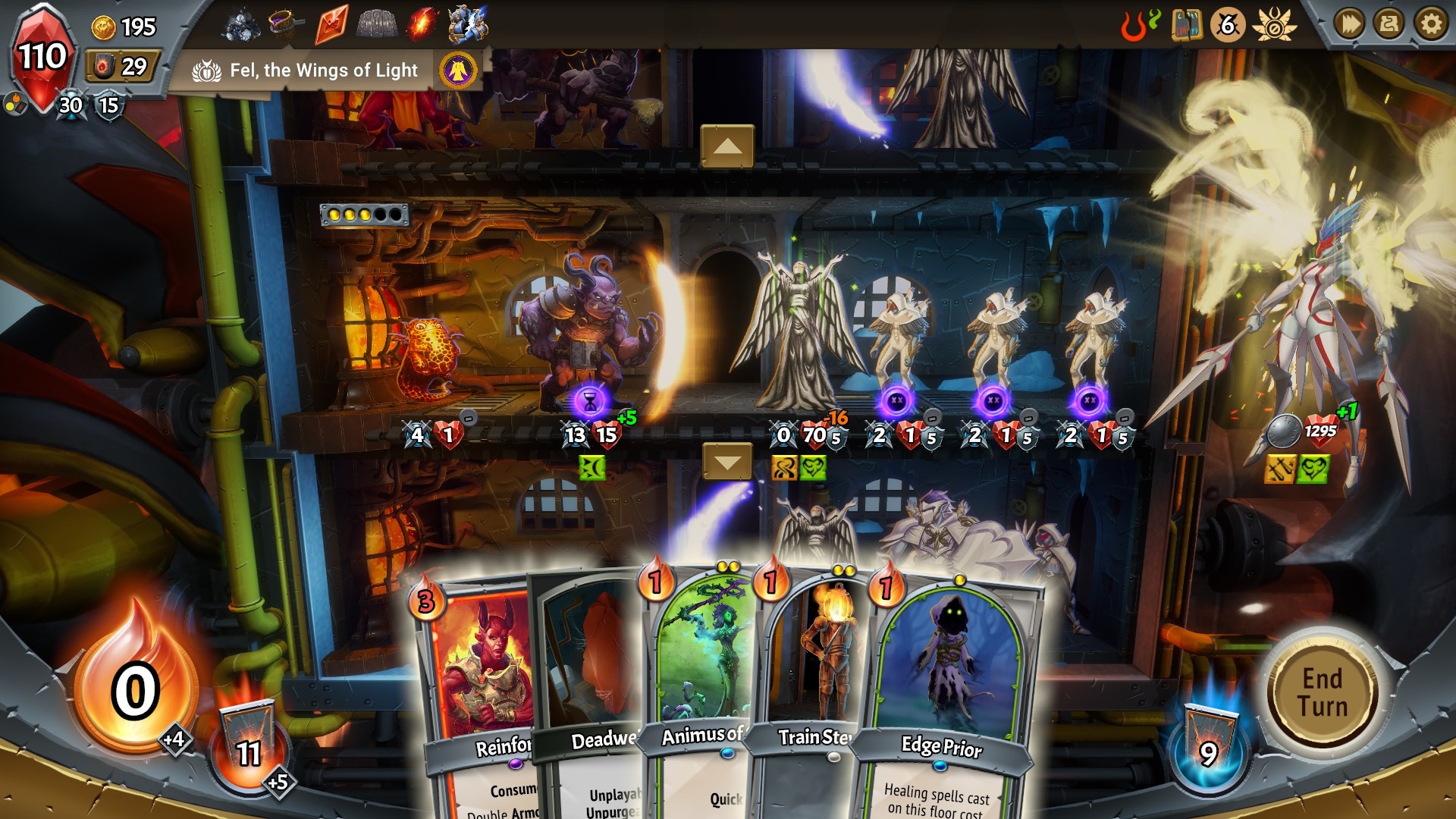
After 47 hours with Monster Train, here's where Shiny Shoe's latest lands on the Roguelike Deck-builder ladder.
Monster Train launched in May 2020, quietly, without the kind of marketing muscle that usually precedes a genre-defining release. Shiny Shoe, a studio better known before this for mobile work, dropped a roguelike deck-builder that somehow managed to carve out its own identity in a space where Slay the Spire had already set what felt like an immovable benchmark. Four years on, with 47 hours logged across multiple runs, multiple clans, and more than a few genuinely embarrassing defeats on Covenant 25, here is where it actually sits.
The short answer: very high. The longer answer requires pulling apart why, because Monster Train earns its reputation through specific, considered design decisions rather than by imitating what Mega Crit built. This is not Slay the Spire with a coat of paint. It is a different argument about what a deck-builder can be.
The Core Conceit Holds Up
The premise is this: Hell has frozen over. You are piloting a train back to rekindle the Pyre at the heart of the underworld, and Heaven's forces are boarding your carriages at every stop trying to stop you. Structurally, that setup translates into three floors of combat space. Enemies climb from the bottom floor upward. You place monster units to intercept them. If they reach the top floor and destroy your Pyre, the run ends. That vertical, positional layer is what separates Monster Train from nearly everything else in the genre.
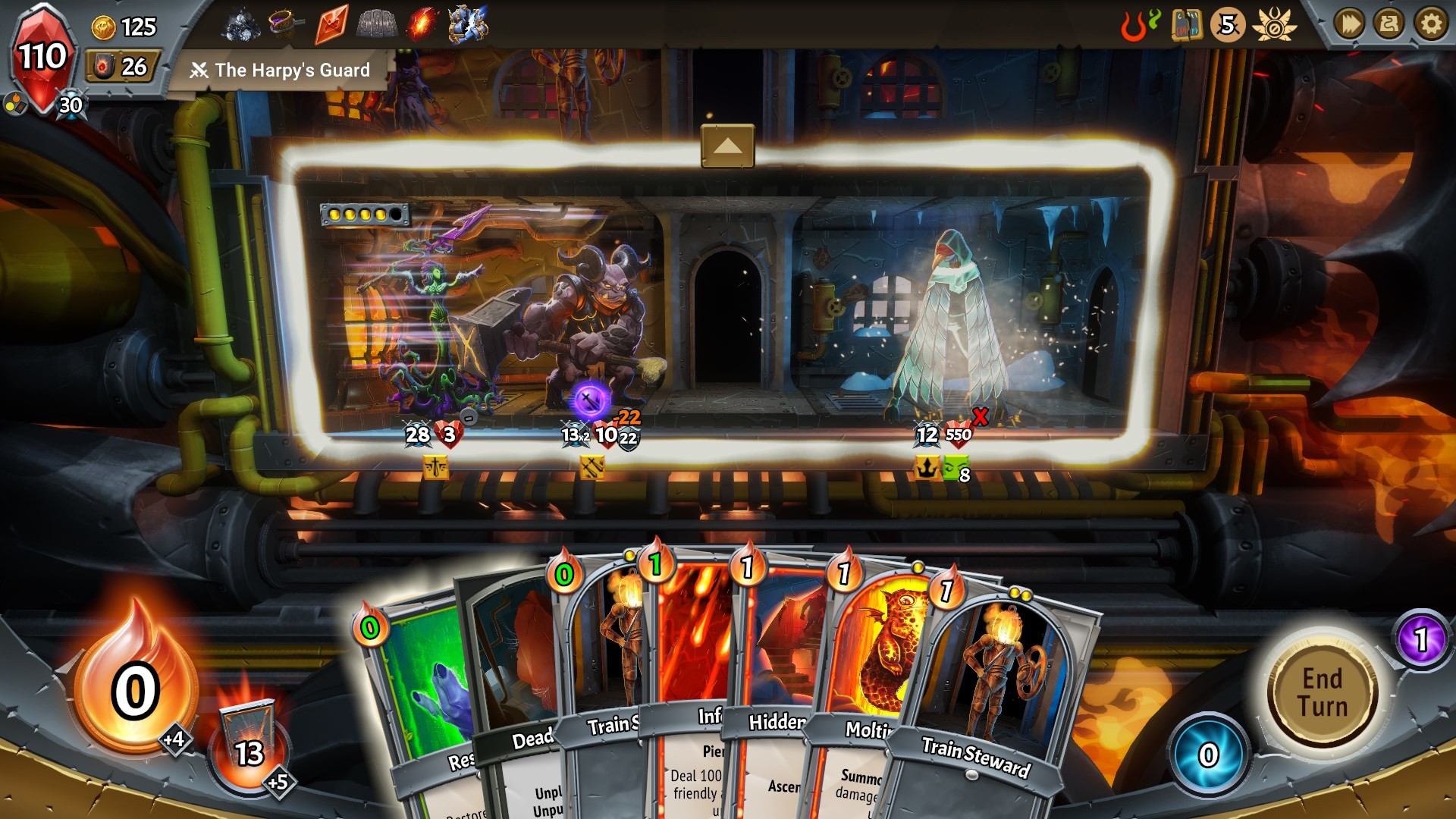
Position actually matters here. A unit with Spikes damage on the front row punishes the first attacker. A unit with Sweep hits every enemy on its floor. A Hellhorned Demon with Rage stacks builds attack across multiple turns, so you want it protected on an upper floor with a Hearth Herald's armor buffs extending its survival window. These are not abstract synergies. They are spatial decisions you make before combat starts, and they change the calculus of every card you play.
After dozens of hours this positional system has not become rote. The enemy compositions change enough, and the unit abilities interact in enough unexpected ways, that floor arrangement stays a genuine problem to solve rather than a checklist to execute.
Clan Pairings Are Where the Design Shines
Monster Train ships with five clans — Hellhorned, Awoken, Stygian Guard, Umbra, and Melting Remnant — and every run asks you to pick a primary and a secondary. The primary gives you access to that clan's units. The secondary gives you spells. This split prevents any single clan from dominating by brute-forcing both halves of the equation, and it creates a combinatorial space that takes a long time to fully explore.
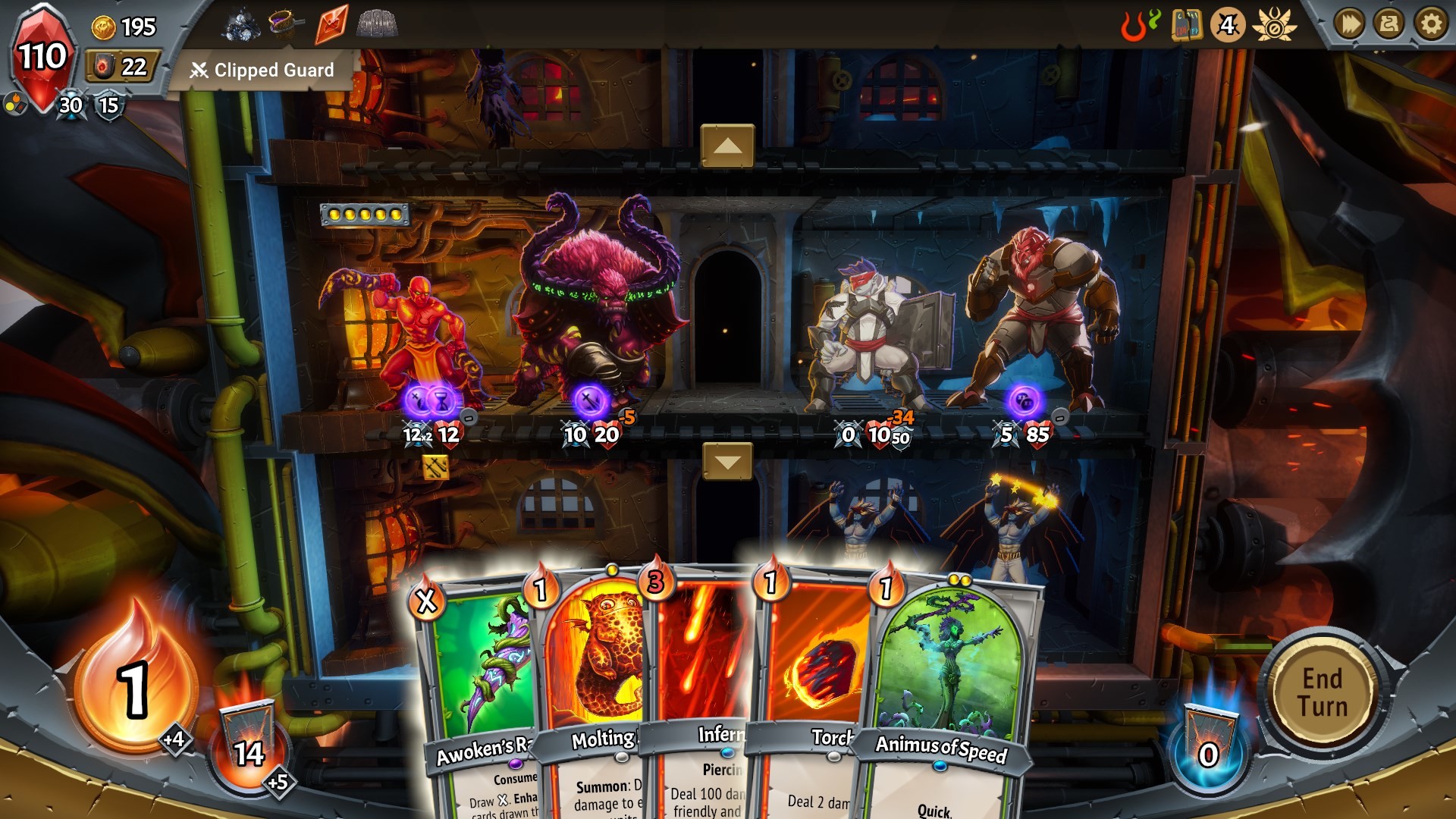
The Melting Remnant alone took me several runs to understand properly. Their units shed into smaller versions of themselves on death, which sounds like a disadvantage until you build around the Endless keyword and Consume mechanics that turn that cycle into a resource engine. Pair them with Stygian Guard's spell-focused cards and you can construct loops that feel genuinely broken in the best sense — the kind of thing that makes you screenshot your end-run deck and send it to people who will not care but must be told anyway.
The sixth clan, Wurmkin, arrived as post-launch content and slots in cleanly. Shiny Shoe's approach to balance across all six has been careful without being sterile. Some pairings are clearly stronger than others at higher Covenant ranks, but nothing feels like a trap that wastes your time.
The Covenant System Does Real Work
Covenant ranks function as Monster Train's difficulty scaling — equivalent to Ascension in Slay the Spire, or the heat system in Hades. Each rank adds a modifier: enemies move faster, your starting Pyre has less health, bosses gain new abilities. By Covenant 10 the game has shed its tutorial skin completely. By Covenant 25, the ceiling, you are playing something that demands a level of build coherence that most casual roguelike players will never need to reach.
What the system gets right is pacing. The early Covenant ranks feel genuinely different from each other rather than just numerically harder. Rank 4 introduces the Seraph boss variants that punish passive, slow-building strategies. Rank 9 adds the Endless modifier to certain enemy waves that forces you to think about sustained damage output rather than burst. Each step teaches you something specific about how the game wants you to think.
There is an argument that the upper Covenant ranks filter out too aggressively — that the difficulty ceiling demands a level of meta-knowledge that transforms the experience from exploration into optimization. That critique has merit. Monster Train at Covenant 22 and above is a different game from Monster Train at Covenant 5, and not everyone will want to follow it that far. But the fact that the depth exists and is coherent rather than arbitrary puts it ahead of most competitors.
Where It Stumbles
The presentation is functional rather than exceptional. The art style communicates its gothic-industrial tone clearly, and individual unit designs are often striking — the Hellhorned Demon's escalating Rage counter is satisfying to watch fill up. But the overall visual vocabulary is less distinctive than, say, Darkest Dungeon's oppressive ink-and-parchment aesthetic or Griftlands' character-driven expressiveness. After 47 hours the UI feels navigable but not elegant. Tooltips occasionally require multiple clicks to fully parse a keyword chain.
The narrative framing also does less than it could. The story of Hell's restoration has personality — the merchant Merchant of Heh is a genuinely funny recurring character — but the lore sits at the periphery rather than being integrated into the run structure the way Supergiant wove Zagreus's relationships into every Hades session. You can play 40 hours and feel like you have barely scratched what the world is trying to say. Whether that matters depends on what you are here for.
Multiplayer — specifically the direct competitive mode added post-launch — is an interesting concept that never quite found its audience. The asynchronous design meant you rarely encountered another player at a comparable skill level. It is still there, technically, but calling it a feature in 2024 would be generous.
How It Sits in the Genre
The roguelike deck-builder space is more crowded now than when Monster Train shipped. Deckbuilders like Roguebook, Cobalt Core, and Wildfrost have all staked out positions in the years since. StS2 remains in active development. Monster Train does not hold every crown in this genre, but it holds specific ones that have not been taken.
No other deck-builder has replicated the three-floor positional combat with the same depth. Cobalt Core tried a grid approach and built something worthwhile, but different. The unit placement layer in Monster Train produces a category of decision-making — where do I put this, and in what order — that feeds into the deck construction in ways that take real time to internalize. That feedback loop between your card choices and your spatial deployment is the game's genuine contribution to the genre.
For 4X and strategy players specifically, Monster Train rewards the kind of systems-thinking that grand strategy demands. Reading enemy wave compositions before placing your units, identifying which floor needs a wall and which needs a sweeper, managing capacity upgrades across multiple floors — it scratches a different itch than pure card optimization. If you have bounced off other deck-builders because they felt too abstract or too linear, Monster Train's spatial layer is worth your attention.
The Verdict After 47 Hours
Monster Train is not a perfect game. Its presentation is competent where it could be memorable, its story is underdeveloped, and its competitive mode is a ghost town. These are real shortcomings, not minor quibbles.
But the core loop — build a deck, deploy units, defend three floors against escalating heavenly violence — remains one of the tightest design arguments in the genre. Shiny Shoe built a machine where the moving parts genuinely interlock. Clan pairings produce emergent strategies that reward experimentation. The Covenant system scales meaningfully without becoming incoherent. The positional layer adds a dimension that most competitors have not matched.
At its current price point, usually around ten to fifteen dollars in a sale, the value calculation is not complicated. If you have put serious time into Slay the Spire and want something that challenges the same part of your brain through a different set of constraints, 47 hours in I am still finding new clan interactions, still losing runs I thought I had locked in, and still coming back the next evening to figure out why.
Verdict
| Category | Score |
|---|---|
| Gameplay | 10/10 |
| Story | 10/10 |
| Visuals | 10/10 |
| Replayability | 9/10 |

Ed Flynn
Ed reviews peripherals — controllers, racing wheels, fight sticks. Calibration nerd.
Frequently Asked Questions
How long does it take to finish Monster Train?
Main story runs around 30-40 hours depending on how thoroughly you explore. Completionists can spend 2-3× that.
Is Monster Train good for newcomers to Roguelike Deck-builder?
Yes — Monster Train is a great entry point. The early hours teach the systems gradually and the difficulty curve is reasonable.
Which platform should I play Monster Train on?
Console version is the most stable on launch. PC version benefits from the modding scene long-term.
Was Monster Train worth the launch-day price?
Depends on backlog. The replay value justifies the price for genre fans; casual players should wait for a 40%+ discount.
Are there DLCs or expansions worth picking up?
The base game is complete; expansion DLC adds 10-15 hours of additional content if you want more.
What did Shiny Shoe get right (and what could be better)?
Shiny Shoe nailed the moment-to-moment loop and the world-building. Pacing in the mid-game and inventory UX have room for improvement.
Comments (5)
Multiplayer mode adds 30+ hours of replay value. Underrated section.
Solid review. I bounced off Monster Train for the first 5 hours, then it clicked.
Score feels about right. The opening drags a bit but it grows on you.
How does it compare to Shiny Shoe's previous work? That's the real question.
Did you notice how the side missions tie back into the main arc? That was a nice touch.