

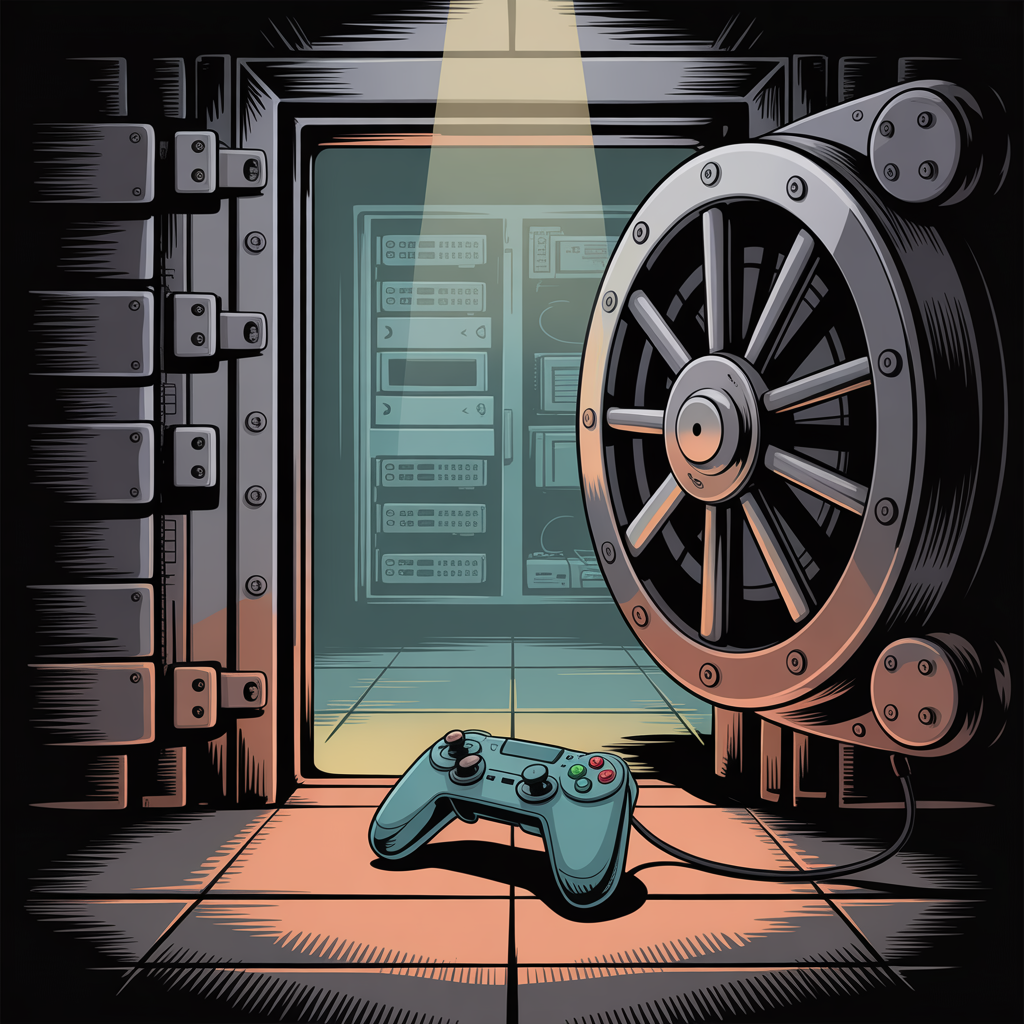
There's a moment in GTA V's Diamond Casino Heist where the planning board in your basement stops being an abstraction. Dozens of prep missions, three distinct approach routes, a rotating cast of hired crew — and then you're standing in a vault beneath the Strip, alarms screaming, and every decision you made in the previous four hours of setup is either paying off or falling apart in real time. Rockstar didn't stumble into that feeling. It was engineered.
The heist subgenre has spent two decades converging on a specific structural formula: extended planning phase, layered execution, climactic set-piece inside a heavily fortified venue. Games as different as Payday 2, Hitman's Mendoza mission, and Like a Dragon: Infinite Wealth all reach for roughly the same shape. Understanding why requires looking at what that shape actually does for a player — mechanically, narratively, and psychologically.
The vault as narrative pressure cooker
Every good heist story needs a destination that justifies the journey. In film, Ocean's Eleven (2001) made this structural logic explicit: eleven characters, each with a specialty, each activated in sequence, all converging on a single guarded room. The vault isn't just the objective — it's the point at which every prior scene is retroactively justified or exposed. Games borrowed this architecture almost wholesale.

When Payday 2 launched in 2013, developer Overkill Software built most of its replayable heists around a hard endpoint — a safe, a server, a bag of cash — surrounded by escalating resistance. The destination creates what designers sometimes call a compression point: a moment where the game's systems stop expanding outward and start closing inward. Players who managed noise levels and guard patrol routes for twenty minutes suddenly have thirty seconds to drill through steel while a SWAT team stacks outside.
Why high-security venues work as level architecture
The architectural logic of a high-security venue maps almost perfectly onto good level design. Multiple floors. Restricted zones. Civilian traffic that complicates lethal approaches. Surveillance systems that reward patience and punish impulsiveness. IO Interactive understood this when designing the Mendoza mission in Hitman 3 — a vineyard estate that functions like a layered puzzle box, with Agent 47 moving through hospitality spaces before reaching the locked-off security core.
Watch Dogs 2's climactic heist sequences use San Francisco's venue architecture similarly: Marcus needs to move through public-facing floors, exploit staff access, and reach server infrastructure that the building's owners would prefer no one thinks about. The social engineering layer — blending in, reading NPC routines — only exists because the building is designed to keep most people out. The restriction generates the gameplay.
Risk-versus-reward systems embedded in the set-piece
What separates the standout heist missions from generic action sequences is granularity of choice during the climax itself. GTA V's three-approach structure for its flagship heist gives players real authorship: the aggressive approach trades planning complexity for raw firepower; the silent option demands meticulous crew management. The player's risk-vs-reward calculus is happening at the mission-select screen, not just during the run.
Red Dead Redemption 2's poker scenes and Yakuza's mahjong parlors operate on a smaller scale but embed the same logic — high-stakes narrative situations dressed in minigame mechanics, where reading opponents and managing resources produces tension that pure gunfights rarely match. Fallout: New Vegas built an entire act around the idea that the most dangerous place in the Mojave is also the most socially complex, and it made Mr. House's tower feel genuinely earned once you reached it.
The planning phase as mechanical investment
Heist games live and die on the gap between planning and execution. The Mafia trilogy understood this even in its more linear framing — the crew scenes, the scouting, the argument about exits — because that investment makes the climax matter. When Sleeping Dogs sends Wei Shen into a back-room operation in Wan Chai, the social infiltration beforehand recontextualises what would otherwise be a straightforward fight.
Saints Row IV and its predecessors occasionally satirised the formula, but they kept the formula. Even when a heist is played for laughs, the structure — intel, crew, execution — remains intact because players have internalised it as the correct shape for this kind of story. Subverting it only works if the template is solid underneath.
What the format demands from players
The heist climax works because it converts systems knowledge into narrative stakes. Everything the player learned — guard timings, alarm triggers, loot locations — gets tested simultaneously under duress. It's the same reason Heat (1995) remains the reference point for the genre: the diner scene tells you who these people are, the heist sequence tests whether they're right about themselves.
Games that chase this structure are essentially building compressed competence tests. The the venue sequence in Like a Dragon: Infinite Wealth sits inside a larger RPG framework, but it functions as a moment where Ichiban's social skills, party composition, and knowledge of the venue's layout all converge. It asks: did you pay attention? The vault, the server room, the fortified floor — they're always asking the same question.
The reason the heist set-piece keeps reappearing across wildly different games isn't nostalgia for crime cinema or a designer's personal aesthetic. It's that the structure genuinely solves a hard design problem: how do you make a finale feel earned rather than arbitrary? Put a locked door at the end of a long corridor. Make the player build the key. Then see if they can keep their hands steady when the alarm goes off.
Comments (4)
How does it compare to the developer's previous work? That's the real question.
The pacing in the second act is exactly the issue that gets glossed over in most reviews.
Best take I've read on this one. The the genre space needs more critical depth.
Spent 60 hours with this. Worth every minute.