

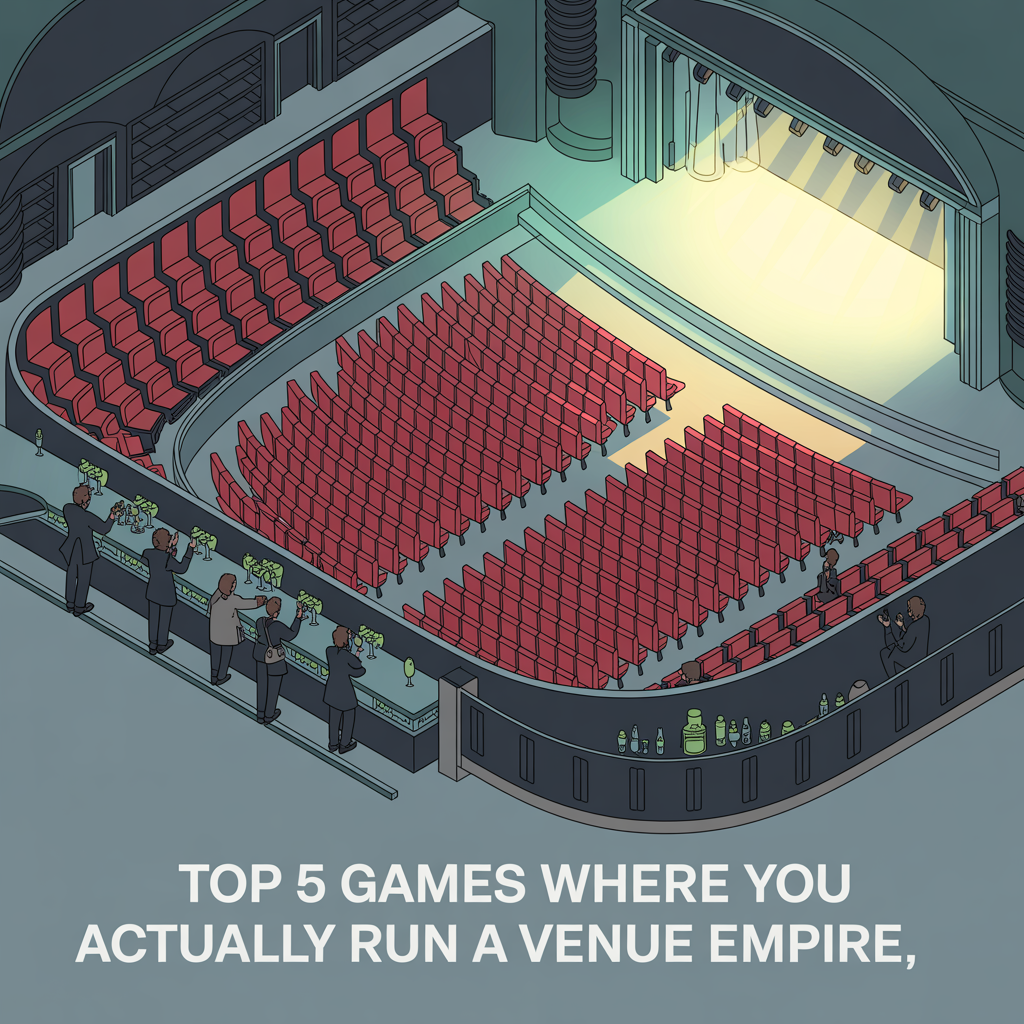
There is a specific fantasy that a certain stripe of strategy game keeps selling, and it goes something like this: you own the floor. Every transaction, every table, every corridor of blinking lights and carefully calibrated noise — you designed it, you staffed it, and you are watching the numbers climb. It is a fantasy that runs through a surprisingly wide range of titles, from the granular supply-chain obsession of RimWorld's trade posts to the full venue-management loops of Theme Park and its descendants. The heist subgenre — Payday 2, GTA V's Diamond Casino Heist, Like a Dragon: Infinite Wealth — approaches the same spaces from the opposite direction, asking what it feels like to tear one apart. Both impulses are about mastery of a system. One builds the machine; the other reverse-engineers it.
What follows is a guide to the five best games about running a venue empire, with detours into where heist-game design has borrowed from, and occasionally improved on, the tycoon formula. The overlapping design DNA is more significant than it might first appear. Games like Fallout: New Vegas and Hitman's Mendoza mission understand venue layout as a puzzle — sight-lines, staff density, customer flow — in ways that owe an obvious debt to the simulation genre. And the simulation genre, in turn, has grown more dramatic, more narrative-driven, borrowing tension from heist cinema. Ocean's Eleven, Heat, Rounders: these films gave game designers a grammar for talking about controlled spaces as arenas of conflict.
1. Planet Coaster (Frontier Developments, 2016)
Frontier's spiritual successor to RollerCoaster Tycoon 3 remains the cleanest expression of the venue-management fantasy. You are not just building rides; you are engineering the experience of walking through a gate and feeling your attention pulled in exactly the direction the designer — you — intended. Path width, queue psychology, shop placement relative to high-adrenaline attractions: Planet Coaster models all of it with unusual fidelity. The guest simulation is granular enough that a badly placed bin will cause measurable litter accumulation, which sounds fussy until you realize that kind of systemic honesty is what separates a real management game from a toy.

The game's financial layer is where things get interesting from a design-theory perspective. Pricing is dynamic and staff morale degrades under mismanagement, so the player is constantly balancing short-term revenue against long-term operational stability. That risk-vs-reward structure — spend now to earn later, or hold reserves for emergencies — is the same structural tension that makes GTA V's three-approach heist arc compelling. In the Diamond The venue Heist, Rockstar forces you to invest in prep missions before you see any return. Planet Coaster makes you feel that same pressure through spreadsheets rather than shootouts.
2. Two Point Hospital (Two Point Studios, 2018)
Two Point Hospital is nominally about healthcare, but its actual subject is queue management and the spatial logic of high-traffic venues. Patients — read: customers — arrive with needs, navigate a physical space toward resolution, and leave either satisfied or not. The hospital is a metaphor, and a thin one. Two Point Studios knew this and leaned into the comedy of it, giving the game a tone closer to a 1990s British sitcom than anything clinically anxious. That tonal choice frees players to think purely about systems, which is where the game's depth lives.
What Two Point Hospital does exceptionally well is the staffing simulation. Doctors, nurses, and janitors have skill trees, morale meters, and break schedules. Neglect any one of those variables and the whole venue starts to degrade in ways that feel physically real — corridors back up, machines break, dissatisfied staff quit mid-shift. It is not hard to see why Hitman's Mendoza level, set across a vineyard and its ancillary spaces, rewards players who study staff patrol patterns with the same attention a Two Point player gives to nurse-to-patient ratios. Both games are arguing that venue control is, at its core, a staffing problem.
3. Frostpunk (11 bit studios, 2018)
Frostpunk earns its place here by being the most morally serious entry in the city-builder/venue-management overlap. You are running a survival camp around a giant generator in a frozen apocalypse, which sounds nothing like a venue empire until you map the mechanics: resource flow, citizen morale, spatial efficiency, the constant negotiation between what the population needs and what the infrastructure can actually provide. The venue, here, is the entire city. And the city is always one bad decision from losing the crowd.
The law system — where players legislate working hours, food rationing, and emergency powers — introduces a layer of systemic tension that pure tycoon games rarely attempt. Every rule change has cascading social consequences. Extend the working day and production climbs, but discontent follows. This is narrative stakes expressed through policy sliders, and it is sophisticated game design. The heist subgenre gestures at similar moral weight in games like Payday 3, where mission planning involves civilian management, but rarely commits to the consequences the way 11 bit studios does.
4. Yakuza 0 (Ryu Ga Gotoku Studio, 2015)
Yakuza 0's real-estate management system is one of the most underappreciated venue-empire simulations in the medium. Kiryu buys and upgrades properties across Kamurocho — hostess clubs, restaurants, leisure venues — and manages a roster of business managers whose performance determines passive revenue. It is a light tycoon layer wrapped inside a brawler, and it works because it is paced correctly: sessions are short, feedback is immediate, and the financial gains feel genuinely connected to the game's main narrative about land and power in 1980s Tokyo.
The series' broader relationship with venue-as-playground is worth noting. Yakuza's leisure districts — dense, neon-lit, full of minigames including mahjong and shogi — are constructed with an almost architectural attention to flow. The spaces feel like real venues because they were modeled on real venues; Ryu Ga Gotoku Studio's reputation for Kamurocho's fidelity to Kabukicho is well-documented. Like a Dragon: Infinite Wealth, the 2024 successor, extends this to Hawaii, with an entirely new resort-district playground. The shift from street-level Tokyo to a tourism economy brings the series closer to resort-management fantasy than it has ever been.
5. Fallout: New Vegas (Obsidian Entertainment, 2010)
No game on this list thinks harder about venue design as political architecture. The Strip in Fallout: New Vegas is not just a backdrop; it is an argument about power, scarcity, and who controls access to pleasure in a post-collapse world. Robert House runs his venue empire through a combination of securitron enforcement and contract law, and the player spends most of the game deciding whether that model is preferable to the alternatives. That is a management simulation question dressed in RPG clothing: what governance structure produces the most stable venue, and at what cost to the people inside it?
Mechanically, New Vegas is clear-eyed about how the venues on the Strip actually function as systems. The Tops, Gomorrah, and the Lucky 38 each have distinct staff behaviors, security arrangements, and spatial layouts that reward players who read the environment carefully before acting. This is exactly what heist-game design demands — Red Dead Redemption 2's poker sequences in Saint Denis, for instance, succeed precisely because the saloon is a legible social system with rules the player can learn to exploit. Obsidian built that kind of systemic legibility into an entire city and then asked you to decide whether to inherit it or burn it down.
Why the Heist Angle Makes These Games Richer
The heist subgenre — shaped so visibly by Heat's operational paranoia and Ocean's Eleven's pleasure in system-gaming — taught players to read venues as machines. Every guard rotation is a variable. Every exit is an asset or a liability. That way of seeing translates directly to tycoon and city-builder design, where the player's job is identical: understand the machine, find its weaknesses, decide whether to patch them or exploit them. Watch Dogs 2's Nudle campus infiltration and the standout mission in GTA V's heist arc both work because they present controlled spaces as puzzles. So does Planet Coaster, with friendlier aesthetics.
The games on this list approach venue empire from the construction side rather than the infiltration side, but they are asking the same underlying question that drives Mafia III's territory-seizure system or Saints Row IV's dominance map: what does it mean to control a space, and how do you hold it? The best management games give that question genuine economic and social weight. The best heist games give it narrative urgency. The overlap, when a developer manages to hit both, produces something that stays with you the way a really good floor plan does — efficient, purposeful, and oddly satisfying to just walk through.
If you have worked through all five of these and are still hungry for the specific flavor of systemic venue control they offer, the next obvious stop is either Offworld Trading Company for its cutthroat market mechanics or the early Tropico entries for their politically absurdist take on resort development. Neither features a single heist sequence. Both will make you think like a criminal about space.
Comments (5)
Spent 60 hours with this. Worth every minute.
How does it compare to the developer's previous work? That's the real question.
Played on Steam Deck — runs great after the proton-experimental fix.
Solid analysis. Did you try the mod community after the 1.2 patch?
Finally finished it last night. Your take on the ending matches mine.